Weather Alert in Washington
Winter Weather Advisory issued March 9 at 1:58PM PDT until March 10 at 8:00AM PDT by NWS Pendleton OR
AREAS AFFECTED: Upper Slopes of the Eastern Washington Cascades Crest
DESCRIPTION: * WHAT...Winter Weather Advisory, snow. Additional snow accumulations between 2 and 6 inches. Winds gusting as high as 30 mph rest of today. Winter Storm Warning, heavy snow expected. Total snow accumulations between 1 and 3 feet. Winds gusting as high as 35 mph 11 pm Wednesday to 5 pm Thursday. * WHERE...Upper Slopes of the Eastern Washington Cascades Crest. * WHEN...For the Winter Weather Advisory, until 8 AM PDT Tuesday. For the Winter Storm Warning, from 5 PM Tuesday to 5 AM PDT Friday. * IMPACTS...Heavy snowfall and very low visibility will create extremely dangerous driving conditions. Gusty winds could bring down tree branches. * ADDITIONAL DETAILS...A strong winter storm will bring heavy mountain snow Tuesday night through Friday morning. There is a lull expected which will occur late Wednesday morning through early Thursday morning as snow levels rise bringing a wintery mix or rain before decreasing Thursday returning heavy snow to pass-level.
INSTRUCTION: Persons should consider delaying all travel. If travel is absolutely necessary, drive with extreme caution. Consider taking a winter storm kit along with you, including such items as tire chains, booster cables, flashlight, shovel, blankets and extra clothing. Also take water, a first aid kit, and anything else that would help you survive in case you become stranded. Do not touch downed lines and report any power outages to your electric company. Travel is highly discouraged due to slick roadways and the possibility of downed trees and power lines. Slow down and use caution while traveling. The latest road conditions can be obtained by visiting the website wsdot.wa.gov/travel.
Want more detail? Get the Complete 7 Day and Night Detailed Forecast!
Current U.S. National Radar--Current
The Current National Weather Radar is shown below with a UTC Time (subtract 5 hours from UTC to get Eastern Time).

National Weather Forecast--Current
The Current National Weather Forecast and National Weather Map are shown below.

National Weather Forecast for Tomorrow
Tomorrow National Weather Forecast and Tomorrow National Weather Map are show below.

North America Water Vapor (Moisture)
This map shows recent moisture content over North America. Bright and colored areas show high moisture (ie, clouds); brown indicates very little moisture present; black indicates no moisture.

Weather Topic: What are Mammatus Clouds?
Home - Education - Cloud Types - Mammatus Clouds
 Next Topic: Nimbostratus Clouds
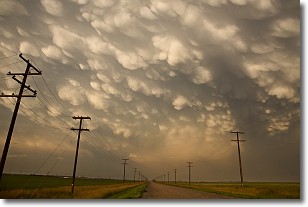
A mammatus cloud is a cloud with a unique feature which resembles
a web of pouches hanging along the base of the cloud.
In the United States, mammatus clouds tend to form in the warmer months, commonly
in the Midwest and eastern regions.
While they usually form at the bottom of a cumulonimbis cloud, they can also form
under altostratus, altocumulus, stratocumulus, and cirrus clouds. Mammatus clouds
warn that severe weather is close.
Next Topic: Nimbostratus Clouds
Weather Topic: What is Precipitation?
Home - Education - Precipitation - Precipitation
 Next Topic: Rain
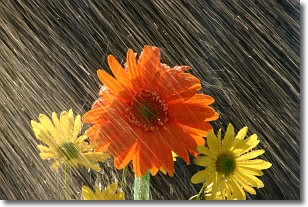
Precipitation can refer to many different forms of water that
may fall from clouds. Precipitation occurs after a cloud has become saturated to
the point where its water particles are more dense than the air below the cloud.
In most cases, precipitation will reach the ground, but it is not uncommon for
precipitation to evaporate before it reaches the earth's surface.
When precipitation evaporates before it contacts the ground it is called Virga.
Graupel, hail, sleet, rain, drizzle, and snow are forms of precipitation, but fog
and mist are not considered precipitation because the water vapor which
constitutes them isn't dense enough to fall to the ground.
Next Topic: Rain
Current conditions powered by WeatherAPI.com